
The only certainties in life, it has long been said, are death and taxes.
We can add to that: Discussions around suet and birds.
Detailed debates include most affordable / flavours birds love best / safest and cleanest / how to discourage starlings from gobbling the entire supply in one go. (See bottom of this post for answer to starling problem.)
Most people are trying to decide among three options for their own suet supply:
• Big box store purchase
• Boutique shop purchase (Avant-Garden falls into this category)
• Homemade suet
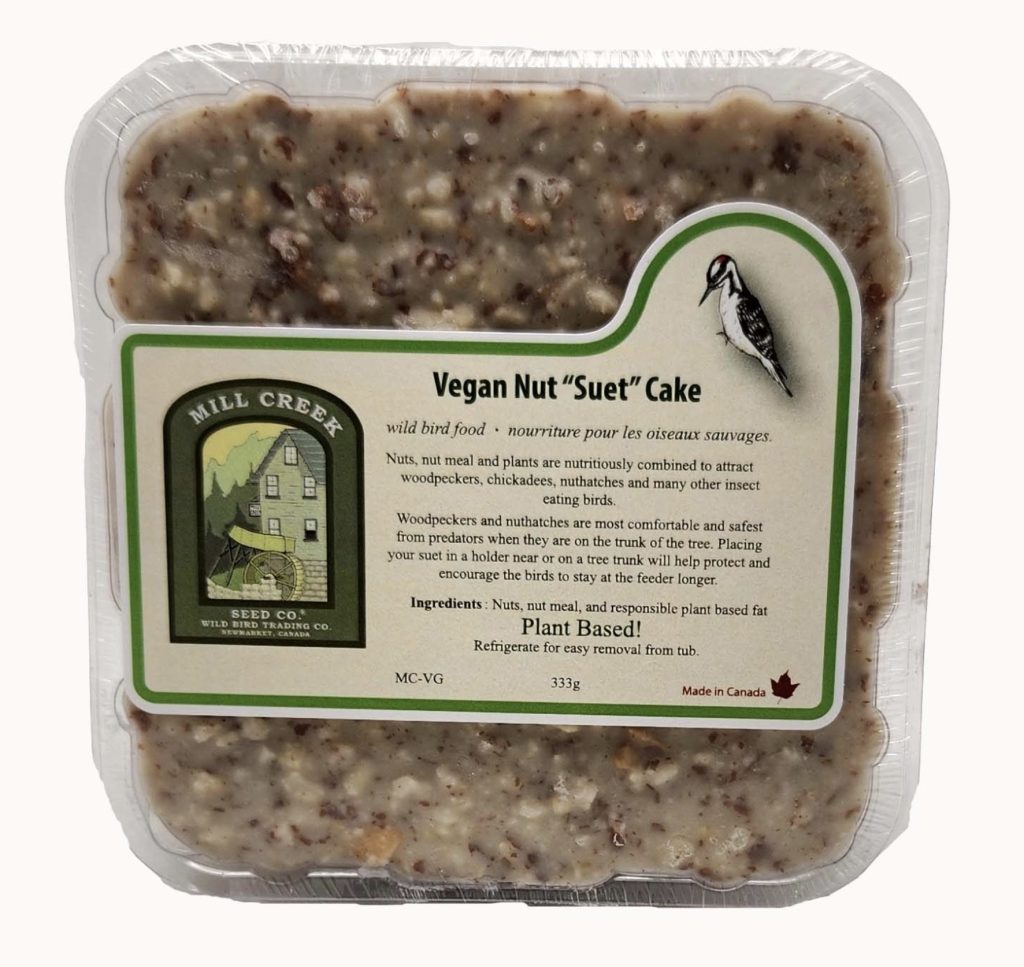
Pictured above is just one of the Mill Creek line of made-in-Canada suet “flavours” we carry. There’s no real suet in this cake, since it’s plant-based, but the birds love it as much as the many other varieties of beef-fat based suets we carry.
Here’s one side of the suet discussions, based on feedback from our customers, who fall into one of two camps:
Camp One are those wanting better results at their suet feeders. Whether they’ve been making their own suet or buying at big box or bulk food stores, they’re not getting the results they’d like. The suet may attract birds at first, but they often don’t return, or they stop feeding from the suet when it’s half finished, having depleted what nutrition was available. These customers often share what they’ve heard from friends or family: that the suet we carry (Mill Creek) brings more birds who stay longer.
Camp Two are customers who will never go back to making their own or buying cheaper suet sold in chain stores. They’re committed to high-quality, professionally produced suet. They’ve seen the red-bellied, downy and hairy woodpeckers who return daily, as well as the nuthatches and chickadees who are regulars. The birds have longer dining stays and the suet cake is consumed down to the very last bite.
Where you get your suet will determine freshness and filler quotient.
In winter weeks, Avant-Garden regularly sells out of suet almost every week. The birds just love the Mill Creek Seed suet cakes.
Thankfully, every Tuesday, Newmarket, Ontario’s Wild Bird Trading Company (who produces the Mill Creek Seed Co. line) replenishes our supply, so there’s no doubt their suet is fresh.
We can’t imagine big box stores are receiving weekly, fresh orders. While cheaper, their products often contain large portions of inedible filler ad may linger on palettes and top shelves for months.
(Search online for videos to see literal meltdowns of suet products side-by-side for ingredient comparison and weights.)
We asked Mark Bennett, President of the Wild Bird Trading Company, to give us some points to share with our customers about comparisons between his Mill Creek suet, homemade suet and the big box products.
AG = Avant-Garden
MB = Mark Bennett
AG: The debate on social media is always about using bacon fat or not in homemade suet for birds. What’s the answer and what else should people know about?
MB: Pork fat is way too salty for birds. It can cause dehydration, it is also vulnerable to bacteria and may have poisonous preservatives. It can affect their central nervous system.
Corn meal is actually good for the birds in winter. It is high in carbohydrates which will keep birds warm on cold nights. It is cheap so that is why it has a bad reputation. Corn is susceptible to mold and lead to aflatoxin if not dried properly. This is a problem. Also, too much corn meal can make the suet crumbly, so don’t use a large amount.
AG: Where are your product ingredients sourced?
MB: All our ingredients are Canadian except the plant-based shortening and peanuts (peanuts are from the US). The shortening is from a Canadian food company but the origin is offshore from various countries.
We ship all across Canada and can barely keep up with the demand.
Currently, there is high demand and a shortage of beef due to droughts, demand for collagen in the cosmetics industry, demand for biodiesel fuel, and an increase in demand for tallow as cooking oil as promoted by RFK in the US.
AG: What do we want to avoid on labels when shopping for suet?
MB: Not recommended ingredients include pork fat, oats, milo, wheat, barley. Not many birds eat oats, just game birds, pheasants, chickens etc.
Most commercial bird suet is rendered and doesn’t need refrigeration. (We only recommend refrigeration to make it easy to remove from the tub.) Rendered suet lasts a year then it becomes a bit stale. It isn’t bad but will attract fewer birds after a year has passed. It should be noted that suet from the butcher is not rendered so it will only last a week at best. Then it will go rancid.
~ We are grateful to Mark Bennett, President of the Wild Bird Trading Company, for taking the time to answer our questions. We carry WBTC’s Mill Creek seed and suet because they are consistently healthy, good bird food with ZERO filler, it’s food that birds love and it is, pound for pound, the same price as cheaper foods with filler that is quite possibly stale or rancid at time of purchase. ~
As for keeping away gorging starlings, the solution is quite simple: provide suet in a cage for upside down perching: the woodpeckers, chickadees and nuthatches can all access it. Starlings cannot.
If you’re interested in adding suet feeders to your bird watching station, come in and have a look at our many options for both food and feeders.
~